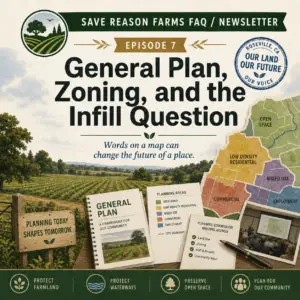
Planning for the Future of Roseville Means Choosing, Not Just Building
The future of Roseville will not arrive by accident. It will arrive one land-use decision, one infrastructure commitment, and one public choice at a time.
The proposed Phillip Road Site project asks the City to make one of those consequential choices. The project would require a General Plan amendment and rezoning of City-owned land at 6382 Phillip Road that is currently designated Public/Quasi-Public and zoned Planned Development. The State CEQA record describes a proposed 176-acre mixed-use development with housing, retail, medical offices, more than one million square feet of innovation-center uses, parks, trails, roadway improvements, utility extensions, and a new electrical substation.
The City describes the project as a mix of residential, commercial, and tech-related “innovation” industrial uses. It also emphasizes that the application remains under review, that the environmental process evaluates potential maximum impacts, and that no tenants or businesses are currently proposed. Those points can coexist: the City must analyze the reasonably foreseeable range of uses before deciding whether the requested land-use changes should be approved.
A Site With More Than One Possible Future
The Phillip Road Site is part of the larger City-owned Reason Farms property. The DEIR states that the City purchased the broader property in 2003 for a retention-basin project funded through the Pleasant Grove/Curry Creek Mitigation Fee program. It further states that later studies identified land considered excess to the retention-basin project’s needs, including the acreage now being evaluated for development, while other land was dedicated as the Al Johnson Wildlife Preserve or retained for the planned stormwater-retention facility.
The current proposal is therefore not the only conceivable future for the property. The DEIR itself evaluates alternatives, which is precisely what CEQA requires when an EIR identifies potentially significant environmental effects.
The first alternative is the No Project Alternative. Under that scenario, no development would occur and the site would remain undeveloped grazing land. The DEIR concludes that this alternative would avoid the project’s construction and operational impacts and is therefore environmentally superior in the broadest sense.
The second alternative is the Reduced Footprint and Development Alternative. It would eliminate development on the northern portion of the site, reduce the development footprint from 176 acres to 128 acres, and eliminate the proposed bridge across Pleasant Grove Creek and the Pleasant Grove Creek Bypass Channel. It would retain mixed uses on the southern portion of the property, but with fewer homes and less total development.
The third alternative is a Residential-only Alternative. It would remove the proposed retail, medical-office, and innovation-center components, but would allow residential development on both the northern and southern portions of the site, including a bridge between them. The DEIR concludes that this alternative could reduce some impacts but could also increase others, including vehicle miles traveled, operational emissions, and demands on public services.
These alternatives do not tell the City what it must decide. They do something more useful: they show that “approve” and “deny” are not the only words in the planning vocabulary. A reduced footprint, different mix of uses, different phasing, stronger infrastructure commitments, or preservation of particular areas are all choices with materially different consequences.
What the Public Comments Ask the City to Answer
The public-comment record featured by Save Reason Farms reinforces that point. Its independently curated document library currently includes Public Comment Letters #1 through #12, along with a comment letter from the Center for Biological Diversity. It should not be mistaken for the City’s complete master index of every comment received, but it provides a useful view of the issues residents and organizations chose to place in the record.
The featured comments collectively ask whether the project is being planned from the ground up or justified after the fact. Public Comment Letter #1 challenges the project-driven General Plan amendment and requests a revised and recirculated DEIR. The Center for Biological Diversity asks the City to correct what it identifies as deficiencies in the environmental analysis. Public Comment Letter #2 questions whether the DEIR adequately analyzes future development associated with a proposed 60-inch sewer line.
Other featured letters raise questions about student pedestrian and bicycle safety; the breadth and clarity of the term “innovation”; mitigation that may be deferred to future plans; neighborhood quality of life; the proximity of intensive uses to homes, schools, and sports fields; localized pollution concerns; enforceable mitigation; solar commitments; on-site greenhouse-gas reductions; and reliance on future fees, mitigation, and assumptions. These are commenters’ arguments, not City findings. Still, their shared question is practical and fair: can residents understand what is being promised before the City approves the project, rather than after the promises become difficult to trace?
Community conversation, including posts on platforms such as Nextdoor, may help identify the everyday concerns people bring to planning: school routes, traffic, noise, creek access, neighborhood character, and whether infrastructure will keep pace. But community posts are context, not technical evidence. The answers should come from the DEIR, engineering studies, enforceable mitigation measures, agency responses, and the Final EIR.
Growth Needs a Plan That Can Be Read
The City states that it has planned for Roseville’s long-term growth for more than 35 years. The relevant question is not whether Roseville should plan. It is whether this particular plan clearly explains its tradeoffs, fully evaluates its alternatives, and provides enforceable commitments for the infrastructure and environmental protections it depends upon.
Good planning does not mean refusing every change. It means making sure that the change is deliberate, understandable, and accountable before it becomes permanent.
A future worth building should also be a future the public can read.