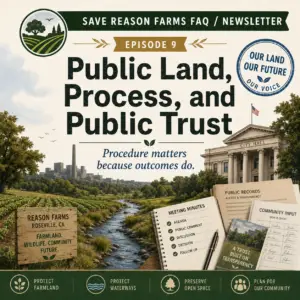
Public Land, Public Trust, and the Phillip Road Site
Public land carries a receipt: it records what taxpayers paid for, what government promised, and what future residents inherit.
That is the larger question behind the proposed Phillip Road Site development at 6382 Phillip Road. The project is not simply a private application on private acreage. The Phillip Road Site remains City-owned (Pubic / Quasi-Public), and the City is simultaneously the property owner, the agency reviewing the development application, and the lead agency responsible for environmental review. The proposal seeks a General Plan amendment, rezoning, permits, a subdivision map, a tree permit, and a development agreement for a mixed-use project that includes housing, commercial space, and tech-related “innovation” industrial uses.
That arrangement is not inherently improper. Cities routinely own land, sell land, and review proposed development. But it does make transparency, clear documentation, and careful public review especially important. Public confidence depends not only on whether a process reaches a lawful result, but also on whether residents can follow the path that led there.
A Public Purpose With a Long History
The current Draft Environmental Impact Report describes the Phillip Road Site as part of the larger City-owned Reason Farms property. It states that the City purchased Reason Farms in 2003 for a stormwater-retention-basin project using development-impact fees collected through the Pleasant Grove/Curry Creek Mitigation Fee program. The City’s current FAQ describes the larger 1,754-acre property as acquired in 2004 for off-channel retention basins intended to store stormwater generated by new development in the Pleasant Grove Creek watershed. The one-year difference in City materials aside, the public-purpose history is consistent: flood-control and stormwater planning were central to the acquisition.
A reasonable public-policy question: when land acquired with drainage-mitigation fees for watershed and public-infrastructure purposes is later considered for sale and rezoning, what standard of clarity should the public expect before that land changes hands or changes character?
The Surplus-Land Record Matters
The City Council declared the parcel surplus in November 2019. It later approved an Exclusive Right to Negotiate agreement with Panattoni in November 2020, a purchase-and-sale agreement in March 2021, and amendments in 2021 and 2022.
In December 2023, the California Department of Housing and Community Development (HCD) issued a Notice of Violation concerning the City’s proposed disposition of the property under the Surplus Land Act. The City and HCD later entered into a settlement agreement effective September 16, 2024. The agreement identifies the property as approximately 236.26 acres, recites the prior option-and-purchase agreement, and provides for a statutory penalty equal to 30 percent of the applicable disposition value, calculated under the settlement’s stated formula.
The settlement is important, but it does not decide the environmental merits of the current project. The previously proposed Roseville Industrial Park application was withdrawn in September 2024, and Panattoni submitted the current revised application the following month. The City says the project remains under review, no City Council action has been taken, and no tenants or businesses have been proposed.
That distinction matters. A settlement can address a land-disposition process. It does not answer separate questions about traffic, water, air quality, habitat, noise, drainage, public services, or the best future use of the site.
What the DEIR and Public Comments Put on the Table
The DEIR evaluates a proposed mixed-use development of approximately 176 acres, including up to 664 residential units, retail and medical-office space, more than one million square feet of innovation-center uses, parks, trails, utility extensions, a new electrical substation, and a roadway bridge across Pleasant Grove Creek and the Pleasant Grove Creek Bypass Channel.
It also identifies significant and unavoidable impacts involving pedestrian and transit facilities, air quality, greenhouse-gas emissions, traffic noise, cumulative utilities and service systems, cumulative visual character, and cumulative light and glare. The DEIR identifies a reduced-footprint alternative as environmentally superior because it would reduce several impacts, though it would not avoid every significant and unavoidable impact.
The Save Reason Farms library presently features an advocacy submission, a letter from the Center for Biological Diversity, and Public Comment Letters #2 through #12. This is a curated public collection, not the City’s official master index of every comment received. Its themes are nevertheless revealing: whether the DEIR is an adequate informational document; possible infrastructure piecemealing connected to a 60-inch sewer line; student walking and bicycling safety; the clarity of the “innovation” label; mitigation deferred to future plans; neighborhood quality of life; proximity of intensive uses to homes, schools, and sports fields; localized effects and off-site mitigation; enforceable CEQA mitigation; solar commitments; on-site greenhouse-gas reductions; and reliance on future fees, plans, or assumptions. These are commenters’ positions, not City findings.
Community discussions, including on Nextdoor, can help identify the everyday questions residents want answered:
- Who benefits?
- What changes first?
- What protections are guaranteed?
The answers must be found in the public record, engineering analysis, environmental review, enforceable mitigation measures, and the City’s eventual responses to substantive DEIR comments.
Public trust is not built by demanding that everyone agree on the future of a site. It is built by making the tradeoffs visible before they become permanent.
For the Phillip Road Site, that means a clear record of the land’s public-purpose history, the terms of any disposition, the project’s environmental consequences, the alternatives considered, and the commitments that will actually be enforceable. Public land deserves nothing less.